
World Association of Electro Shock Survivors
Founded by Survivors. Fighting for the Right to Refuse.
The 1993 Texas Campaign
Founded in 1993 by Douglas G. Cameron and Dian’a Loper, the World Association of Electro Shock Survivors (WAESS) grew out of a successful Texas campaign to establish legal protections against involuntary electroconvulsive therapy (ECT).
Cameron, an ECT survivor who had advocated for legislative reform in Texas for approximately two decades, initiated the effort that became Senate Bill 205. Loper, an ECT survivor and former Texas lobbyist, joined the campaign and brought her legislative and organizing experience to the effort. Together they organized survivors and advocates and worked with Texas legislators to pass the legislation.
Signed into law by Governor Ann W. Richards in June 1993, S.B. 205 prohibited ECT for children under 16 and established significant protections for patients’ right to refuse ECT, including meaningful informed consent and the right to withdraw consent at any time.
Today, WAESS continues that work internationally. The organization brings survivors and other concerned individuals together to advocate before legislatures, regulatory agencies, and international institutions for the prohibition of ECT altogether where possible, the prohibition of ECT for children, the elimination of forced ECT, and meaningful, voluntary informed consent.
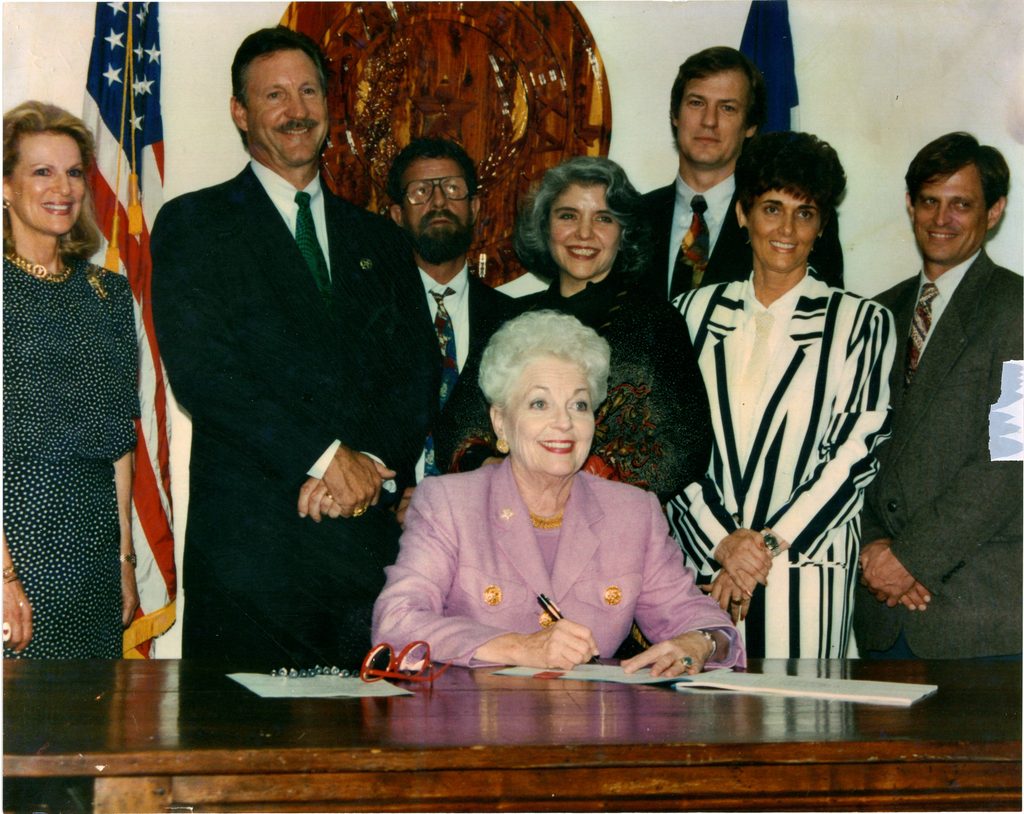
After years of advocacy by Douglas G. Cameron, the campaign for legislation reached a turning point in the early 1990s.
Cameron had been speaking before the Texas Legislature and mental-health organizations about forced electroshock since approximately 1973. He had written and published about his own experience, worked within mental-health advocacy organizations, participated in efforts concerning the Texas Mental Health Code, and become a lay authority on ECT equipment and its effects.
Senate Bill 205 emerged from investigations by Texas Senators Judith Zaffirini, Mike Moncrief, and Chris Harris into private mental-health facilities. Cameron testified before the senators about forced electroshock and the absence of meaningful consent. The proposed legislation sought to protect patients from involuntary ECT and establish specific safeguards concerning its use.
Dian’a Loper joined the campaign shortly before the bill came before the Senate Health and Human Services Committee. Loper was herself an electroshock survivor and had extensive previous experience as a Texas lobbyist. Together, Cameron and Loper organized other survivors to testify before the Legislature and founded the World Association of Electro Shock Survivors.
The campaign ultimately succeeded.
S.B. 205 passed the Texas Senate 31–0 on March 25, 1993. It passed the House on May 22, 1993, and the Senate concurred in the House amendments on May 25. Governor Ann W. Richards signed the legislation into law on June 16, 1993.
What S.B. 205 Accomplished
The legislation created Chapter 578 of the Texas Health and Safety Code, establishing specific statutory protections concerning electroconvulsive therapy.
S.B. 205 prohibited ECT for anyone under 16 years of age.
For patients 16 and older, S.B. 205 established an important distinction between involuntary psychiatric treatment and legal incompetency. An involuntary patient who had not been adjudicated by a court to be incompetent to manage his or her personal affairs could not be given ECT without that patient’s own consent. Thus, involuntary hospitalization or a finding of dangerousness did not, by itself, satisfy the statutory exception to the patient’s right to refuse ECT.
Only where a patient had been formally adjudicated incompetent to manage his or her personal affairs and had a legally appointed guardian of the person could a guardian consent to ECT on the patient’s behalf. Even then, the statute required the guardian’s decision to be based on knowledge of what the patient would have desired, if that desire was known.
The statute further required that consent be voluntary and without coercion or undue influence, and expressly provided that a patient or guardian could revoke consent at any time, with revocation taking effect immediately.
The law also required written information concerning the nature and purpose of ECT, its known risks and side effects, the possibility of permanent and irrevocable memory loss, the remote possibility of death, the existence of disagreement concerning the efficacy of the procedure, and the expected degree and duration of improvement or remission.
Importantly, the written consent requirements applied before each individual ECT treatment.
S.B. 205 also established registration and oversight requirements for ECT equipment and required facilities and physicians to report information concerning ECT and certain other convulsive or coma-producing therapies. Required reporting included such matters as fractures, reported memory losses, incidents of apnea, cardiac arrests, and deaths occurring within 14 days following treatment.
The principal provisions of the law took effect September 1, 1993, with certain provisions taking effect immediately.
From Texas to the World
The creation of WAESS grew directly out of the 1993 Texas campaign.
The Texas legislation demonstrated what survivors could accomplish when they organized, testified publicly, worked with legislators, and refused to accept the assumption that patients should surrender their right to make decisions about their own bodies.
WAESS continues that work.
Today, Douglas G. Cameron, a survivor of ECT and a longtime advocate concerning electroconvulsive treatment and ECT equipment, leads WAESS in an effort to bring survivors and non-survivors together into a powerful international advocacy movement.
WAESS seeks to petition and engage Congress, the World Health Organization, the National Institute of Mental Health, the U.S. Food and Drug Administration, the U.S. Department of Health and Human Services, the European regulatory authorities, the International Electrotechnical Commission, state legislatures, and institutions throughout the world concerning the regulation and use of ECT.
Our objectives include:
- prohibiting ECT altogether where possible;
- prohibiting ECT for children;
- eliminating forced ECT;
- protecting meaningful, voluntary informed consent;
- protecting the right of individuals to refuse ECT;
- informing the public about the history, risks, effects, and regulation of ECT;
- bringing survivors and other concerned individuals together for legislative and regulatory advocacy; and
- pursuing meaningful reform of ECT practices and equipment worldwide.
The Work Continues
The Texas campaign of 1993 was not the end of the struggle. It was the beginning of a larger effort.
WAESS was founded by people who had personally experienced electroshock and decided that what happened to them should not simply be accepted as inevitable. More than three decades later, that principle remains at the center of the organization:
A person should have the right to understand a proposed treatment, to give meaningful consent, and to refuse it.
WAESS exists to carry that principle forward.